The iron doesn't care about your goals — but your programming should. Two of the most popular approaches to resistance training are powerlifting and bodybuilding, and while they share the same equipment and many of the same exercises, their philosophies, rep schemes, and end goals are fundamentally different. Choosing between them — or finding the right blend — can make or break your long-term progress.
This guide breaks down both disciplines honestly, without the tribal loyalty that often clouds these conversations. Whether you're a complete beginner or an intermediate lifter looking to specialize, understanding these differences will help you train with more intention and get better results.
What Is Powerlifting?
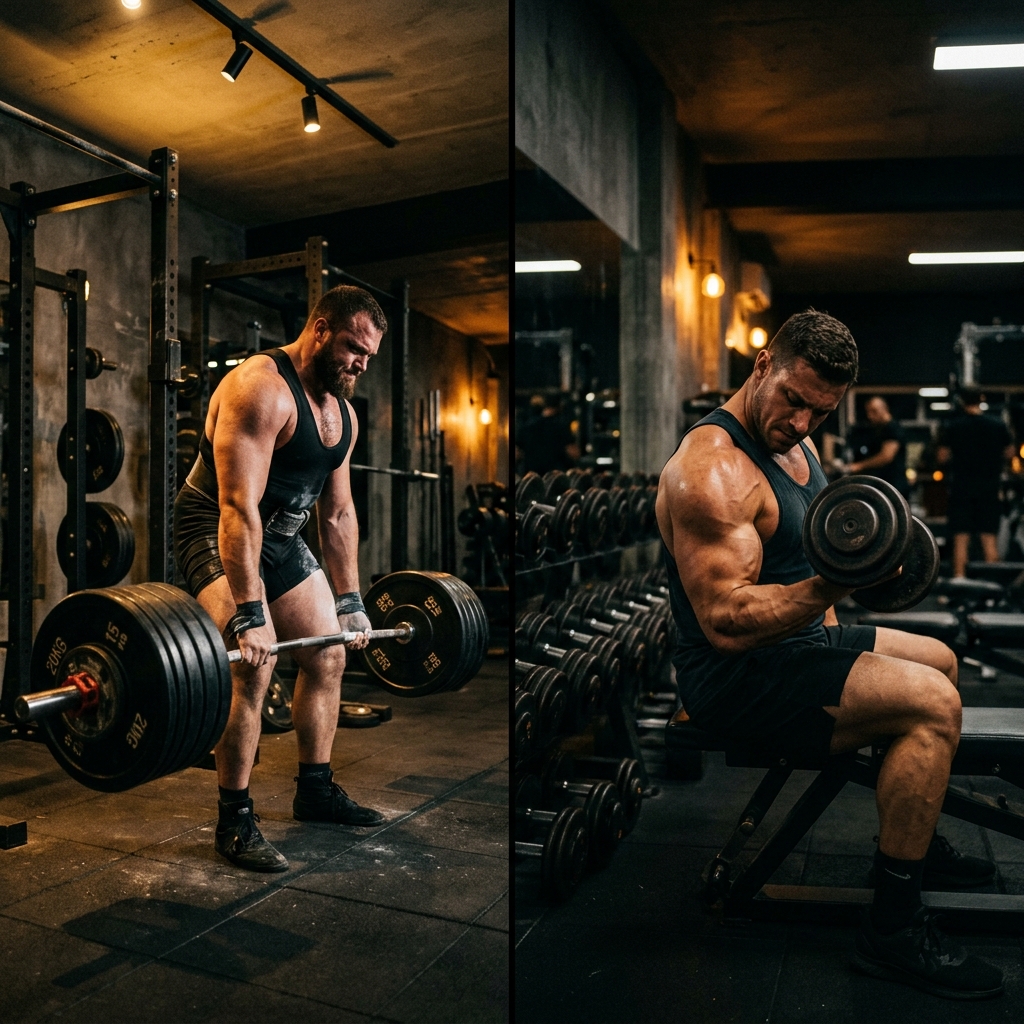
Powerlifting is a competitive strength sport centered around three lifts: the squat, bench press, and deadlift. The goal is simple — lift the heaviest weight possible for a single repetition in each lift. Competitions are judged on total weight moved across all three lifts, with athletes competing in specific weight classes.
Powerlifting training revolves around low-rep, high-intensity work. Typical programming features sets of 1–5 reps at 75–100% of your one-rep max (1RM), with long rest periods of 3–5 minutes between sets. Accessory work supports the main lifts — you might do Romanian deadlifts to strengthen your hamstrings for your competition deadlift, or close-grip bench press to improve lockout strength.
The powerlifting mindset is about performance metrics. Your 1RM numbers are your scoreboard. Progress is measured in pounds added to the bar, and every training cycle is designed to peak for a new personal record. It's straightforward, measurable, and deeply satisfying for people who thrive on quantifiable progress.
What Is Bodybuilding?
Bodybuilding is about building the most aesthetically developed physique possible — maximizing muscle size, symmetry, proportion, and conditioning (low body fat with visible muscle definition). Competitive bodybuilders are judged on stage based on how they look, not how much they can lift.
Bodybuilding training prioritizes hypertrophy — the biological process of increasing muscle fiber size. This means moderate-to-high rep ranges (8–15 reps per set, sometimes 15–20+), moderate loads (60–75% of 1RM), shorter rest periods (60–90 seconds), and a strong emphasis on the mind-muscle connection — deliberately feeling the target muscle work through the full range of motion.
Volume is king in bodybuilding. A typical bodybuilder might perform 15–25+ sets per muscle group per week, spread across multiple sessions. Isolation exercises like cable flyes, lateral raises, and leg curls play a much larger role than in powerlifting, because the goal is to develop every individual muscle, not just move maximum weight.
Key Differences at a Glance
- Goal — Powerlifting: max strength in squat/bench/deadlift. Bodybuilding: maximum muscle size and aesthetics
- Rep Range — Powerlifting: 1–5 reps. Bodybuilding: 8–15+ reps
- Intensity — Powerlifting: 75–100% 1RM. Bodybuilding: 60–75% 1RM
- Rest Periods — Powerlifting: 3–5 minutes. Bodybuilding: 60–90 seconds
- Exercise Selection — Powerlifting: compound-focused. Bodybuilding: compound + isolation
- Periodization — Powerlifting: peaks toward competition. Bodybuilding: progressive overload with deload phases
- Nutrition — Powerlifting: performance fuel, less focus on leanness. Bodybuilding: precise calorie and macro tracking with bulk/cut cycles
- Judging — Powerlifting: weight on the bar. Bodybuilding: visual assessment on stage
The Hybrid Approach: Powerbuilding
Here's the secret most experienced lifters eventually discover: you don't have to choose just one. Powerbuilding — a hybrid approach that combines heavy compound work with hypertrophy-focused accessory training — has gained massive popularity because it delivers both strength and size.
A powerbuilding session might start with heavy squats (4 sets of 3 at 85% 1RM) and finish with leg press, leg curls, and lunges for higher reps (3–4 sets of 10–12). You get the neural adaptations and strength gains from the heavy work, plus the muscle growth stimulus from the volume work. It's the best of both worlds, and it's the approach many MaxGrind users gravitate toward.
If you're new to lifting, powerbuilding is arguably the best starting point. You'll build a strong foundation with the big compound lifts while also developing the muscle size that makes you look like you actually train. As you gain experience, you can specialize further if competition in either sport interests you.
How to Decide What's Right for You
Ask yourself what motivates you. If you get fired up watching someone grind out a massive deadlift PR, and you love the idea of testing your absolute limits, powerlifting might be your calling. If you're more driven by visual changes — watching your shoulders widen, your arms fill out, your waist tighten — bodybuilding will keep you hungry.
Whatever path you choose, track everything. Use MaxGrind to log your sets, reps, and weights, monitor your PRs over time, and build routines that align with your chosen discipline. The athletes who make the fastest progress are the ones who train with intention and measure their work. The grind doesn't care about your style — it only cares that you show up.